The Emotionally Intelligent Principal
$37.00
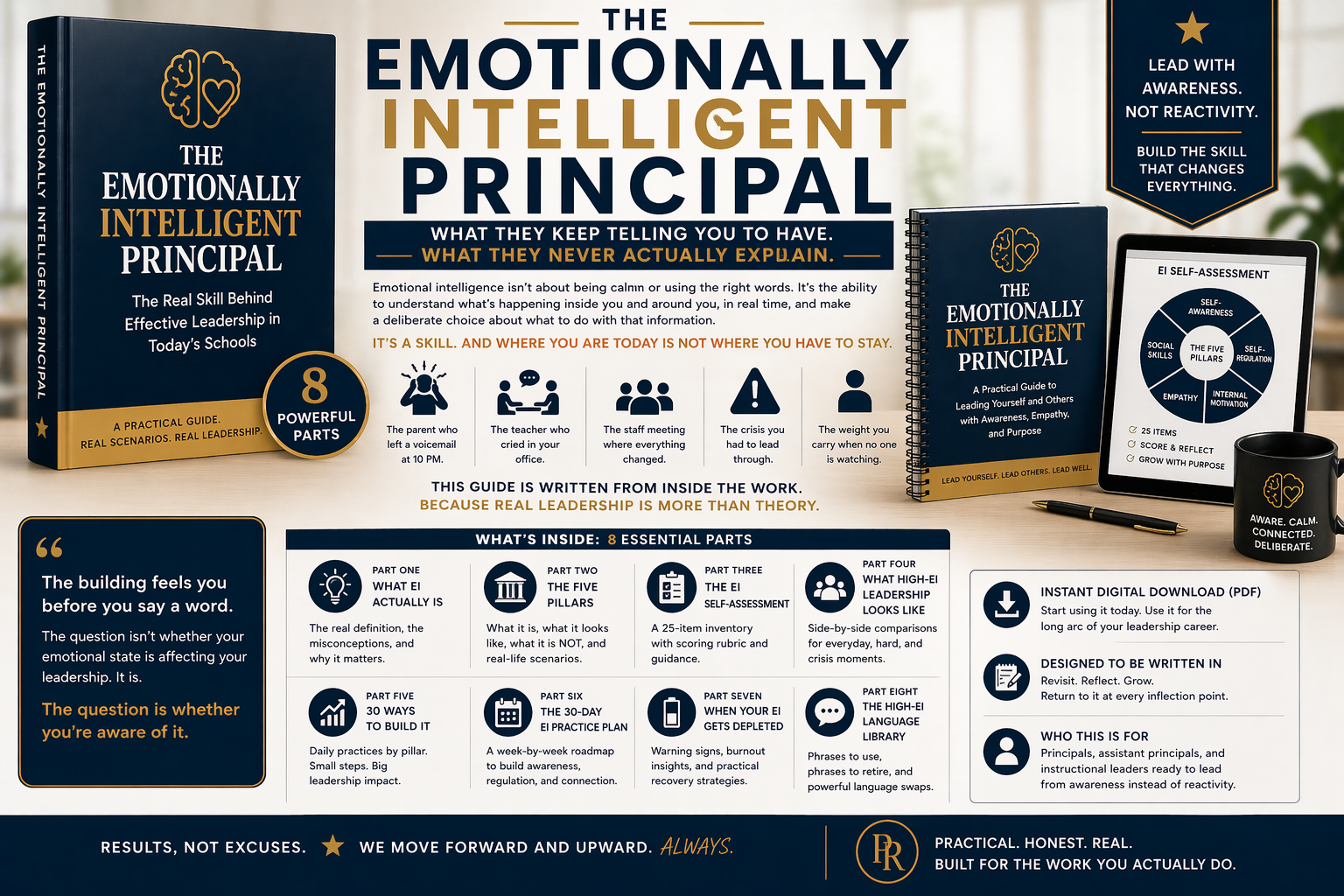
The guide to emotional intelligence they told you to have but never actually explained. Five pillars, a 25-item self-assessment, 30 specific practices, and a 30-day plan — built for real principals in real buildings, not for TED-talk theory. Because your staff can feel your emotional state before you say a word. The only question is whether you’re aware of it.
Description
THE EMOTIONALLY INTELLIGENT PRINCIPAL
What they keep telling you to have. What they never actually explain.
You’ve heard the phrase in every leadership PD. It’s on every “effective principal” rubric. Your superintendent drops it in meetings like it’s self-evident. And somewhere in the back of your mind, you’ve wondered: do I actually have it? Am I failing at it right now? What does it even mean in this building, with these 600 kids, with the parent who left me a voicemail at 10 PM, with the teacher who cried in my office this morning?
Here’s what nobody tells you: emotional intelligence is not a gift some people are born with and others aren’t. It’s not about being calm when everything is on fire. It’s not about crying with your staff or using therapy language in a faculty meeting. It’s not about being liked.
It’s the ability to understand what’s happening inside you and around you, in real time, and make a deliberate choice about what to do with that information. That’s it. That’s the whole thing. And it’s a skill — which means where you are today is not where you have to stay.
Most resources on this topic are written by people who have never run a building. They’ve never held a staff meeting four hours after a phone call from HR changed everything. They’ve never had to smile at a child who doesn’t know their teacher is on a PIP. They’ve never had to lead people through a crisis while carrying one of their own.
This guide is different — because it’s written from inside the work.
What’s inside:
- Part One — What EI Actually Is. The real definition, the misconceptions that hurt you, and why low-EI leadership makes the job harder on everyone.
- Part Two — The Five Pillars. Self-Awareness, Self-Regulation, Internal Motivation, Empathy, and Social Skills. For each one: what it actually is, what it looks like in your building, what it is NOT, and a real scenario grounded in your life.
- Part Three — The EI Self-Assessment. An honest 25-item inventory mapped to all five pillars, with scoring rubric and guidance on where to start. Not a diagnostic — a mirror.
- Part Four — What High-EI Leadership Actually Looks Like. Side-by-side comparisons: how a high-EI principal handles day-to-day leadership, hard conversations, and crisis moments — versus a low-EI or depleted one. In real language, not theory.
- Part Five — 30 Ways to Build It. Specific daily practices organized by pillar. Small enough to do on any given day. Meaningful enough to actually move the needle over time.
- Part Six — The 30-Day EI Practice Plan. A week-by-week roadmap: Awareness → Regulation → Empathy & Connection → Integration. Not about doing everything perfectly. About starting.
- Part Seven — When Your EI Gets Depleted. The cognitive, behavioral, and relational warning signs. The high-empathy–burnout connection nobody warns you about. Practical recovery — not vacation advice.
- Part Eight — The High-EI Language Library. Phrases that signal EI. Phrases to retire. Language swaps you can use tomorrow — the specific sentences that change how a room responds to you.
What this guide will not do: make the hard parts of leadership comfortable. Emotional intelligence doesn’t remove the difficulty — it gives you the internal steadiness to move through it well.
What it will do: help you see yourself more clearly, build deliberate practices instead of white-knuckling it, and lead from awareness instead of from reactivity.
Who this is for: Principals, assistant principals, and instructional leaders who are tired of being told to have EI without anyone explaining what it actually requires — and who are willing to take an honest look at themselves.
Format: Instant digital download (PDF). Designed to be written in, returned to, and used for the long arc of a leadership career.
“The building feels you before you say a word. The question isn’t whether your emotional state is affecting your leadership. It is. The question is whether you’re aware of it.”
— Dr. Tania Loyola | Principal Realities