Difficult Conversations Script Guide
$14.97
Ten word-for-word scripts for the conversations nobody trained you to have. The teacher who isn’t improving. The parent who’s screaming. The final warning that has to hold up legally. The colleague you have to let go with dignity. Real language. No corporate filters. Because the conversation you keep avoiding is costing you more than the one you need to have.
Description
DIFFICULT CONVERSATIONS SCRIPT GUIDE
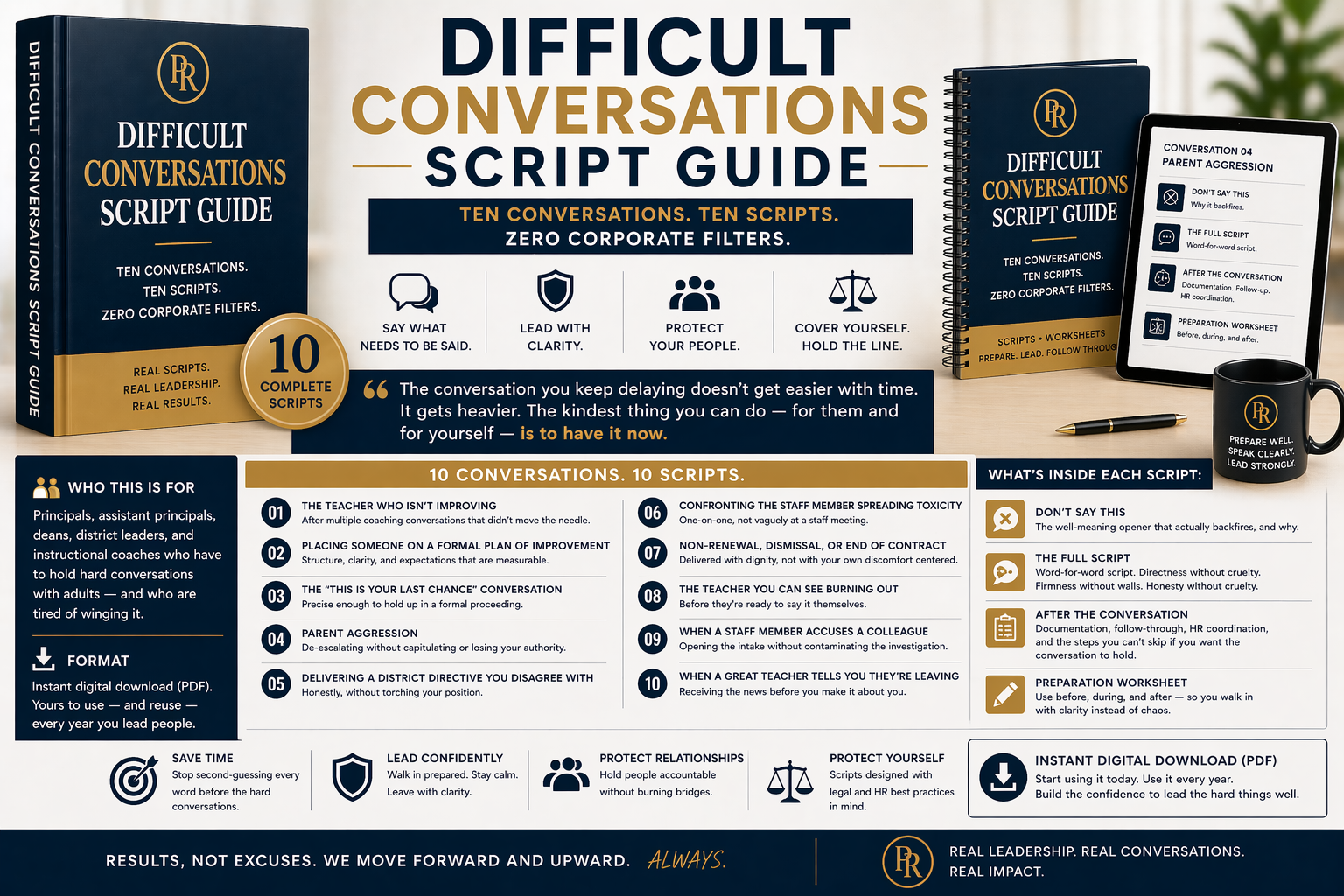
Ten conversations. Ten scripts. Zero corporate filters.
You know what you need to say. You just don’t know how to start.
Nobody trained you for this part. The evaluation protocols, the walkthrough forms, the data binders — sure, some version of that. But the conversation where you have to look a teacher in the eye and tell them they’re not making it? The moment a parent is screaming and you have to stay steady? The final warning that has to hold up legally and humanly at the same time? The call you make when a great teacher tells you they’re leaving?
Nobody handed you a script. They expected you to figure it out — and in the meantime, you stayed up the night before rehearsing something you weren’t sure was right, walked into a hard room, and either said too much, too little, or something you immediately regretted.
This guide is exactly what I wish someone had handed me.
Ten complete scripts, word-for-word, for the conversations that make school leaders lose sleep:
- The teacher who isn’t improving — after multiple coaching conversations that didn’t move the needle
- Placing someone on a formal Plan of Improvement
- The “this is your last chance” conversation — precise enough to hold up in a formal proceeding
- Parent aggression — de-escalating without capitulating or losing your authority
- Delivering a district directive you disagree with — honestly, without torching your position
- Confronting the staff member spreading toxicity — one-on-one, not vaguely at a staff meeting
- Non-renewal, dismissal, or end of contract — delivered with dignity, not with your own discomfort centered
- The teacher you can see burning out — before they’re ready to say it themselves
- When a staff member accuses a colleague — opening the intake without contaminating the investigation
- When a great teacher tells you they’re leaving — receiving the news before you make it about you
What’s inside each script:
- “Don’t say this” — the well-meaning opener that actually backfires, and why
- The full word-for-word script — directness without cruelty, firmness without walls, honesty without cruelty
- “After the conversation” — documentation, follow-through, HR coordination, and the steps you can’t skip if you want the conversation to hold
- A Preparation Worksheet to use before, during, and after — so you walk in with clarity instead of chaos
A note on how to use this:
These are not scripts to memorize. They’re scaffolds — a place to start so the opening sentence doesn’t trip you. Plug in their name. Adapt the specifics. Let your humanity show through the structure. What these scripts won’t do is make the conversation comfortable. Difficult conversations are supposed to be uncomfortable — that discomfort is a sign you’re taking them seriously. What they will do is make sure you never walk into one again wishing someone had told you how to start.
Who this is for: Principals, assistant principals, deans, district leaders, and instructional coaches who have to hold hard conversations with adults — and who are tired of winging it.
Format: Instant digital download (PDF). Yours to use — and reuse — every year you lead people.
“The conversation you keep delaying doesn’t get easier with time. It gets heavier. The kindest thing you can do — for them and for yourself — is to have it now.”
— Dr. Tania Loyola | Principal Realities